OnyxCubes

CFOP vs ROUX: A Detailed Comparison

The Rubik’s Cube has fascinated puzzle enthusiasts since its invention in 1974. Over the years, numerous solving methods have been developed, each with its unique approach and advantages. Among these, CFOP (Cross, F2L, OLL, PLL) and ROUX are two of the most popular and widely used methods.

In this article, we’ll dive deep into both methods, compare their differences, and discuss their advantages and disadvantages to help you decide which one might be better for you.


What is CFOP?

CFOP, also known as the Fridrich Method, is the most widely used method for solving the Rubik’s Cube, especially among speedcubers. It consists of four main steps:

CFOP Cross | OnyxCubes.com
CFOP F2L | OnyxCubes.com
CFOP OLL | OnyxCubes.com
CFOP PLL | OnyxCubes.com
  1. Cross: Solve the cross on the first layer (typically the white face).
  2. F2L (First Two Layers): Pair up and insert the corner and edge pieces of the first two layers simultaneously.
  3. OLL (Orientation of the Last Layer): Orient the pieces of the last layer so that the top face is a single color.
  4. PLL (Permutation of the Last Layer): Permute the pieces of the last layer to solve the cube.

CFOP is known for its efficiency and is the method of choice for most world-class speedcubers. It relies heavily on algorithms, with 78 algorithms for full CFOP (57 for OLL and 21 for PLL).

What is ROUX?

ROUX First Block | OnyxCubes.com
ROUX Second Block | OnyxCubes.com
ROUX CMLL | OnyxCubes.com
ROUX LSE | OnyxCubes.com

ROUX is an alternative method that takes a block-building approach to solving the cube. Gilles Roux developed it and consists of the following steps:

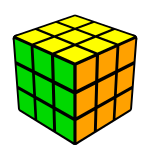
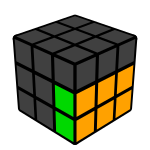
  1. First Block (FB): Build a 1x2x3 block on the left or right side of the cube.
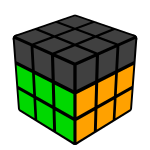
  2. Second Block (SB): Build a second 1x2x3 block on the opposite side, completing the first two layers.
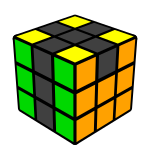
  3. CMLL (Corners of the Last Layer): Solve the corners of the last layer using a set of algorithms.
  4. LSE (Last Six Edges): Solve the remaining six edges without disturbing the solved corners.

ROUX is known for its intuitive nature and lower reliance on algorithms compared to CFOP. It emphasizes efficiency in moves and is favored by cubers who prefer a more creative and flexible approach.


CFOP vs ROUX Key Differences

AspectCFOPROUX
ApproachLayer-by-layer solving with a focus on algorithms.Block-building with an emphasis on intuition and fewer algorithms.
Move CountTypically 55-60 moves on average.Typically 45-50 moves on average, making it more efficient in theory.
AlgorithmsRequires memorizing 78 algorithms for full CFOP.Requires only 42 algorithms for full ROUX (9 for CMLL and 33 for LSE).
LookaheadRequires strong lookahead during F2L to maintain speed.Lookahead is important during block-building and LSE.
Cube RotationsInvolves frequent cube rotations, especially during F2L.Minimizes cube rotations, as most steps are performed on the same axis.
IntuitivenessLess intuitive; relies on memorizationMore intuitive; focuses on logical solving.
Speed PotentialHigh TPS (turns per second); proven recordsCompetitive but generally slower for top times
PopularityThe most popular method among speedcubers.Less popular but has a dedicated following.
Learning CurveSteeper; requires more time to masterEasier for beginners; less memorization needed
One-Handed SolvingLess optimalMore ergonomic; better suited for one-handed

Advantages and Disadvantages

CFOP

Advantages:

  1. Widely Used: CFOP is the most popular method, so there are abundant resources, tutorials, and community support.
  2. Algorithm-Based: Once you learn the algorithms, solving becomes fast and consistent.
  3. High-Speed Potential: CFOP is the method used by most world record holders, making it ideal for competitive speedcubing.
  4. Structured Learning: The step-by-step nature of CFOP makes it easier to learn and improve incrementally.

Disadvantages:

  1. High Algorithm Count: Memorizing 78 algorithms can be daunting for beginners.
  2. Cube Rotations: Frequent rotations can slow down solves if not executed efficiently.
  3. Less Intuitive: F2L requires practice to become intuitive, and beginners may struggle with pairing pieces.

ROUX

Advantages:

  1. Lower Move Count: ROUX is more efficient in terms of moves, which can lead to faster solves.
  2. Fewer Algorithms: Only 42 algorithms are needed for full ROUX, making it easier to learn.
  3. Minimal Cube Rotations: ROUX minimizes rotations, which can save time during solves.
  4. Intuitive Solving: Block-building encourages creativity and spatial awareness.

Disadvantages:

  1. Less Popular: Fewer resources and tutorials are available compared to CFOP.
  2. Harder Lookahead: Block-building and LSE require strong lookahead skills, which can be challenging for beginners.
  3. Limited Community Support: Fewer cubers use ROUX, so finding advice or tips can be harder.

Which Method is Better?

The answer to this question depends on your goals, preferences, and solving style:

  • Choose CFOP if:
    • You want to follow the most popular and well-documented method.
    • You’re aiming for competitive speedcubing and want to achieve the fastest possible times.
    • You don’t mind memorizing a large number of algorithms.
    • You prefer a structured, step-by-step approach.
  • Choose ROUX if:
    • You want a more intuitive and creative solving experience.
    • You prefer fewer algorithms and a lower move count.
    • You want to minimize cube rotations and focus on efficiency.
    • You’re willing to invest time in mastering block-building and lookahead.

Both CFOP and ROUX are excellent methods for solving the Rubik’s Cube, and each has its own strengths and weaknesses. CFOP is the go-to method for speedcubers aiming for the fastest times, while ROUX offers a more intuitive and efficient approach with fewer algorithms. Ultimately, the best method is the one that aligns with your personal preferences and solving style.

If you’re new to cubing, you might want to start with CFOP due to its extensive resources and community support. However, if you’re looking for a fresh challenge or want to explore a different approach, ROUX is a fantastic alternative. Whichever method you choose, practice and dedication will be key to mastering the Rubik’s Cube!

Happy cubing! 🎉

onyxcubes

    Leave a Reply

    Your email address will not be published. Required fields are marked *

    OnyxCubes
    Explore OnyxCubes from beginner to expert tutorials, tips, and tricks to master the Rubik's Cube. Twist, turn, and triumph in cubing!
    © 2026 OnyxCubes. All rights reserved.
    OnyxCubes